The lever escapement is not the most elegant solution to the problem of regulating a watch. It is not the most efficient. It does not have the lowest friction, the cleanest impulse, or the most theoretically satisfying geometry. It is, however, the most practical escapement ever devised for the specific conditions of a portable watch — robust, self-starting, tolerant of the shocks and orientations that a wristwatch endures — and this combination of properties has made it the dominant escapement in mechanical watchmaking for two and a half centuries.
Thomas Mudge is credited with its invention, around 1755, though the design evolved substantially before reaching its modern form. Mudge — the same Thomas Mudge who attempted a marine chronometer and was involved in the Longitude Prize competition — was a London watchmaker of the first rank. His lever escapement replaced the verge escapement that had regulated portable timekeepers since the fourteenth century, and it so thoroughly displaced everything else that came after it that today, when someone says "mechanical watch," the lever escapement is almost certainly what they mean.
What an Escapement Does
Before examining the lever, it is worth establishing what an escapement is required to do. The mainspring, when wound, stores energy. Left unconstrained, this energy would drive the gear train to run down in seconds — the hands would spin and stop. The escapement is the mechanism that controls the release of this energy, parcelling it out in discrete steps timed by the oscillating balance wheel. Each swing of the balance allows the gear train to advance by exactly one tooth of the escape wheel. The rate at which the balance oscillates determines the rate at which the watch runs.
The escapement must do three things well. First, it must lock the gear train securely when the balance is not ready to receive an impulse. Second, it must release the gear train cleanly when the balance arrives, delivering a precise impulse to maintain the balance's oscillation without disturbing its period. Third, it must protect the balance from the gear train between impulses — the balance must be free to oscillate without interference from the rest of the movement.
Different escapements solve these requirements in different ways, with different trade-offs. The lever escapement's solution has proven, over two and a half centuries of refinement, to be the most satisfactory balance of all the competing demands.
"The lever escapement is not clever in any particular — it is clever in aggregate. Each of its features compensates for a weakness in the others. The result is an organism, not a machine."— George Daniels, Watchmaking
How It Works
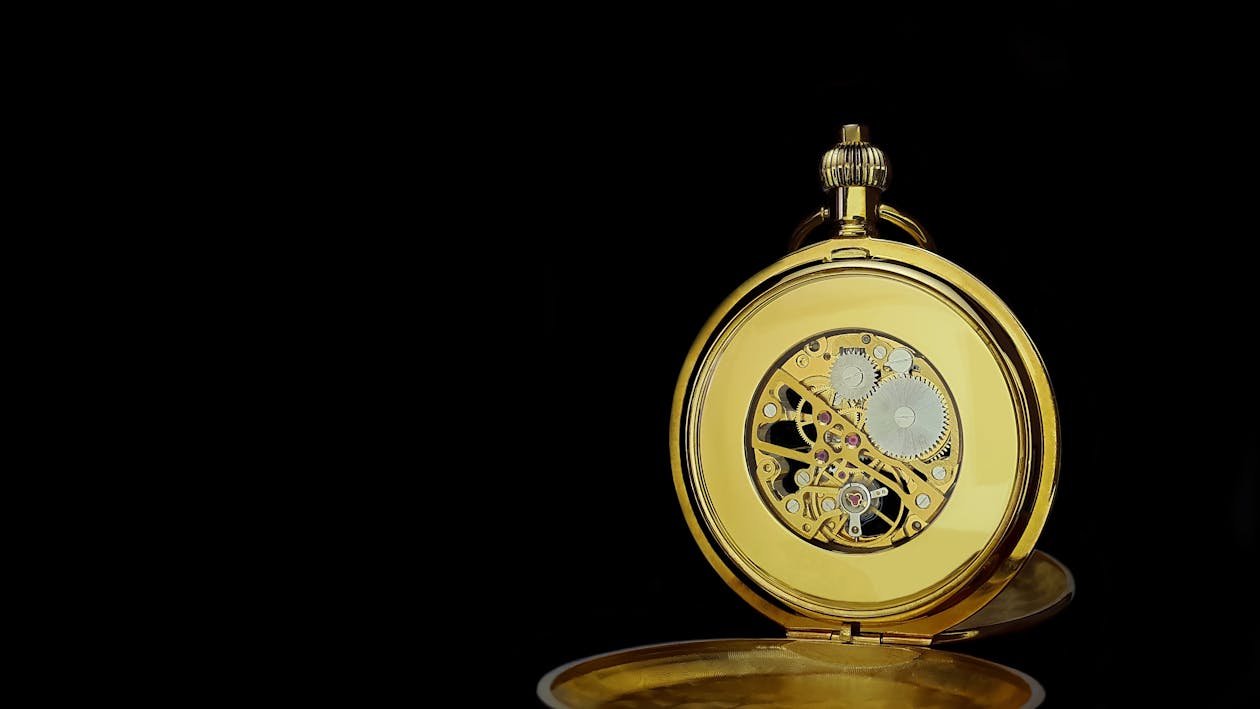
The lever escapement consists of three principal components: the escape wheel, the pallet fork, and the balance wheel. The escape wheel is a toothed wheel driven by the gear train. The pallet fork is an L-shaped or T-shaped lever pivoted at its centre, with two pallet stones — typically ruby or synthetic sapphire — mounted at its ends. The balance wheel is the oscillating regulator, connected to the pallet fork by a thin roller pinion.
The operation is sequential. As the balance swings in one direction, its roller engages the pallet fork and pushes it. The fork pivots, releasing one tooth of the escape wheel. As the tooth slides past the releasing pallet stone, it delivers an impulse — a push — to the pallet fork, which transmits the impulse to the balance through the roller. The fork pivots until the second pallet stone catches and locks the next tooth. The balance continues its swing, free of the fork, oscillates back, and the sequence repeats in reverse.
This happens several times per second. In a watch beating at 28,800 vibrations per hour — the modern standard — the balance oscillates four times per second. In a high-frequency movement beating at 36,000 vph, five times per second. Each oscillation involves the fork catching, releasing, and re-catching the escape wheel. The precision required in the geometry of the pallet stones, the depth of lock, the draw angle, and the roller dimensions is extraordinary — measured in fractions of a millimetre, in angles of fractions of a degree.
Why Nothing Has Replaced It
Since Mudge's time, watchmakers have invented dozens of alternative escapements: the detent escapement, the duplex escapement, the virgule, the co-axial, the remontoire — each claiming some advantage over the lever. The detent escapement, used in marine chronometers, has lower friction and delivers a cleaner impulse, but it is delicate, not self-starting, and unable to withstand the shocks of wrist wear. The co-axial escapement, invented by George Daniels in 1974 and adopted by Omega in 1999, reduces sliding friction significantly and requires less lubrication — but even Omega continues to produce lever escapement watches alongside it.
The lever has survived because its apparent disadvantages — friction at the pallet stones, the energy lost in the detent action — are manageable at the tolerances of modern manufacturing, while its advantages — robustness, self-starting, insensitivity to shock — are irreplaceable in a watch worn on a human wrist. A marine chronometer, resting in its gimballed case in a ship's chart room, can afford the delicacy of a detent escapement. A watch strapped to a cyclist's wrist cannot.
Refinement Without Revolution
What has changed in the lever escapement over 250 years is not its fundamental geometry but the precision and materials of its execution. Pallet stones that were once made of stone or polished steel are now synthetic ruby or sapphire, harder and more precisely shaped. The geometry has been optimised through decades of trial and calculation. Oils have improved, allowing the escapement to run with less friction for longer periods. Manufacturing tolerances that were once achievable only by skilled hand work are now attainable by CNC machines that cut to micron-level accuracy.
The result is that the lever escapement in a modern movement, produced to modern tolerances and serviced at modern intervals, performs better than the lever escapements of the nineteenth century — not because the design has changed substantially, but because everything around it has improved. It is one of the rare examples of a technology so well-suited to its purpose that progress has consisted entirely of doing the same thing better, rather than doing something different.
This longevity is, in itself, the most eloquent argument for the lever escapement. The watch industry is not conservative out of laziness; it has examined, and occasionally adopted, alternatives. The lever escapement has survived this scrutiny repeatedly. In a field as competitive as precision timekeeping, where the search for improvement never stops, the fact that an 1765 invention remains the standard in 2026 is not tradition. It is proof.