
Abraham-Louis Breguet is remembered for many things: the tourbillon, the pare-chute shock protection, the guilloché dials, the pomme hands that bear his name. But among watchmakers, the invention they most admire — the one they consider most technically significant — is the overcoil hairspring, or as it is known in French, the virole Breguet. It is smaller, less dramatic, and less visible than the tourbillon. It is also, by the judgment of horological history, more important.
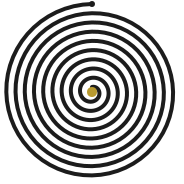
The hairspring is the heart of a mechanical watch's timekeeping. It is a coiled spring of extraordinary thinness — in a modern wristwatch, typically three to five micrometres thick, coiled into a flat spiral of a dozen or more turns — attached at its inner end to the balance wheel's staff and at its outer end to the balance cock. As the balance wheel oscillates, the hairspring alternately compresses and expands, storing and releasing energy, regulating the frequency of the oscillation and thus the rate of the watch.
The Problem with Flat Springs
A flat spiral hairspring has an inherent problem: as it expands and contracts, it does not breathe concentrically. The outer coils move more than the inner coils, the spring's centre of mass shifts slightly with each oscillation, and the balance wheel is subject to a small but measurable lateral displacement. This displacement introduces errors in the period of oscillation that depend on the amplitude of the balance's swing — a property called isochronism, or rather the lack of it.
A watch with poor isochronism runs at different rates depending on the power remaining in the mainspring. When freshly wound and running at full amplitude, it runs at one rate. As the mainspring runs down and the amplitude decreases, it runs at another. This is not a small effect: a poorly designed hairspring can produce rate variations of thirty seconds per day or more depending on the state of wind. For a watch intended for navigational or scientific use, this is catastrophic.
Various remedies had been attempted before Breguet. The fusee — a cone-shaped gear that equalises the force delivered by the mainspring throughout its run — addressed the amplitude variation by keeping the driving force more constant. This helped but did not eliminate the problem, because the hairspring's geometry remained inherently non-concentric.
"The overcoil is Breguet's most intellectual invention — not a mechanism but a geometry, a mathematical insight applied to metal. It corrects an error not by force but by form."— David Landes, Revolution in Time
The Overcoil Solution
Breguet's solution, developed around 1795 and described in his patent applications of the period, was geometrical rather than mechanical. He modified the terminal curve of the hairspring — the outermost coil as it attaches to the balance cock — bending it upward out of the plane of the remaining coils and shaping it into a specific curve. This elevated outer terminal, the overcoil, allows the spring to expand and contract more concentrically: the outer coil, instead of pressing against the adjacent inner coil during expansion, rises above the plane and moves outward freely.
The mathematics of the correct terminal curve — the precise shape it must take to produce truly concentric breathing — were worked out by Breguet empirically and later formalised by mathematical analysis. The resulting form is a specific arc, neither circular nor elliptical, whose exact profile depends on the number of coils and the spring's material properties. Getting it right requires either precise calculation or, as Breguet himself did it, an intuition cultivated over years of observation and experiment.
The Difficulty of Making It
The overcoil is simple in concept and enormously difficult in execution. Forming the terminal curve requires heating the spring to a precise temperature, bending it over a former to the correct radius, and allowing it to cool — a process that, if performed at the wrong temperature or with too much force, ruins the spring entirely. Hairsprings are among the most sensitive components in watchmaking; a fingerprint's worth of oil, a grain of dust, or a breath of humid air can alter their properties measurably. Forming an overcoil without damaging the spring is a skill that takes years to acquire.
At Breguet's workshop in the Quai de l'Horloge, overcoils were formed by hand, one at a time, by craftsmen who had learned the technique through direct instruction. The springs themselves were made from a drawn steel wire of extraordinary consistency — achieving uniformity in the wire was itself a separate technical challenge, requiring careful drawing dies and precise heat treatment. The entire process, from wire to finished spring, was as much art as manufacture.
The Legacy in Every Mechanical Watch
The Breguet overcoil became standard practice in high-grade watches by the mid-nineteenth century and remains so today. Almost every mechanical watch with serious horological pretension — from a Patek Philippe to a George Daniels — uses a hairspring with a Breguet overcoil terminal. The exceptions are watches with silicon hairsprings, where the material's different elastic properties allow alternative terminal geometries to achieve similar results, and a small number of movements where a flat spring is used with other isochronism corrections.
The universality of the overcoil is the best measure of its significance. It was not patented in a form that prevented competitors from using it — Breguet was more interested in technical excellence than in monopoly — and so it spread rapidly through the Swiss and English trade after his death in 1823. Two centuries later, the forming of Breguet overcoils remains a benchmark skill for the watchmaking apprentice, a rite of passage that connects the student directly to the tradition Breguet established.
What is remarkable about this legacy is how invisible it is to the watch's wearer. The overcoil sits under the balance cock, hidden from view in most watches, requiring a loupe and a removed caseback to see at all. Its contribution — the improvement in isochronism that it produces — is measurable only on a timing machine. And yet this invisible component, formed with such care and difficulty, is one of the things that separates a watch that keeps good time from a watch that keeps excellent time. Breguet understood that excellence, in watchmaking, is often invisible to the person who benefits most from it. He made the overcoil anyway.
