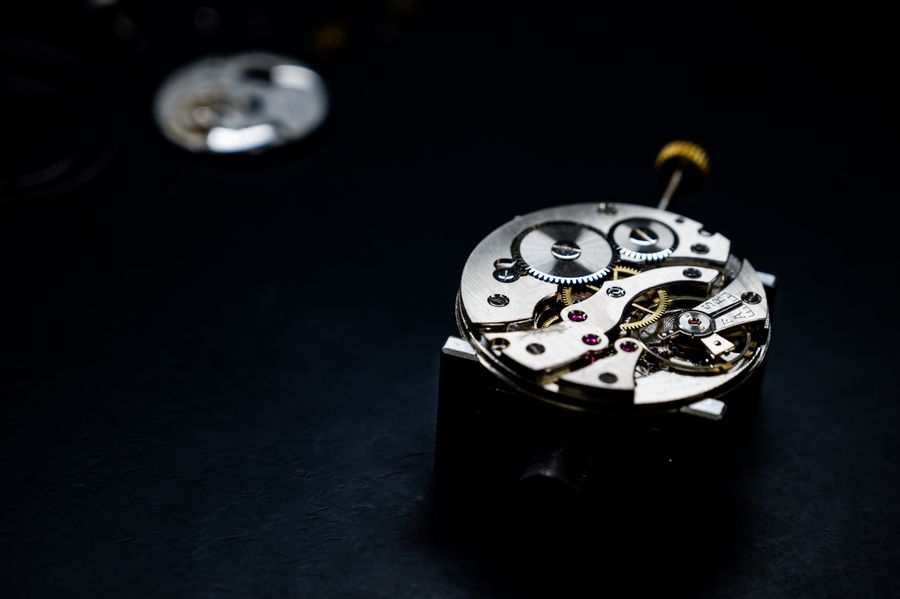
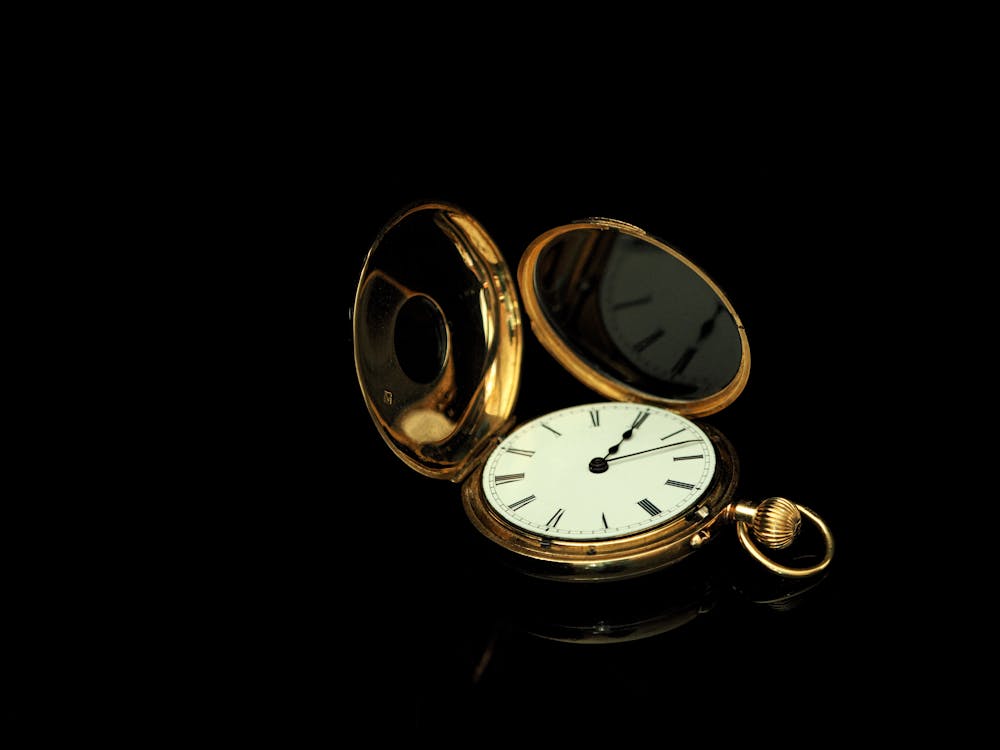
Look closely at the dial of a fine Swiss pocket watch from the late nineteenth century. Beneath the enamel, or sometimes visible through it, you may see a pattern of extraordinary regularity: overlapping waves, or a sunburst of radiating lines, or the basket-weave of the clous de Paris motif. The lines are perfectly even, the crossings perfectly spaced, the geometry so precise that it suggests the work of a machine. And it is — but a machine operated with an artist's touch, through a process called guilloché, on an instrument called the rose engine lathe.
Guilloché is the art of engine turning: the use of a mechanically guided cutting tool to engrave repetitive geometric patterns into metal. The patterns are achieved not by drawing or stamping but by the controlled eccentric rotation of the workpiece against a fixed cutter, with the eccentricity of the rotation programmed by a set of cams — called rosettes — that give the machine its name. Different rosettes produce different waveforms; their combination, and the movement of the carriage between passes, determines the final pattern.
A Technique of Many Centuries
Engine turning predates horology. Ornamental lathes capable of decorative work appear in European workshops by the sixteenth century, and the aristocracy of the seventeenth century regarded a rose engine as a prized possession — King Louis XVI of France was an enthusiastic amateur turner, and the tool was fashionable enough to appear in the inventories of several French royal residences. The technique was applied to silver, gold, ivory, and tortoiseshell before watchmakers adopted it for dials and cases.
Its application to watch dials developed primarily in Geneva and Fleurier in the late eighteenth century, where the combination of guilloché and translucent enamel — champlevé enamel poured over a guilloché ground, so that the pattern shows through as a shifting moiré beneath the colour — became one of the defining aesthetic achievements of the era. The effect is unlike anything produced by printing or photoengraving: it changes as the light changes, as the viewing angle shifts, as the colours of the room move across it.
"Each pass of the cutter is irreversible. There is no correction, no return. The guilloché artisan works as the surgeon works — with complete commitment to each incision, knowing that the next cut depends on all those that came before."— Anita Porchet, master enameller, on the demands of guilloché work
The Machine and the Hand
What is easy to misunderstand about guilloché is how much of it is manual. The rose engine is a machine in the sense that it guides the cut — but the operator controls the depth of cut, the speed of the pass, the pressure on the cutter. A slight variation in any of these produces a visible irregularity in the finished pattern. The skill required to produce perfectly consistent lines across a surface of several centimetres — repeating the same motion hundreds of times with the same pressure and the same depth — is a physical as well as an intellectual skill, built over years of practice.
The patterns themselves have names accumulated over two centuries of use. Clous de Paris is the pyramid-stud pattern, its squares so small that they appear as a fine texture at normal viewing distance. Grain d'orge — barleycorn — runs overlapping ovals in two directions to create a rippling surface. Soleil radiates straight lines from a central point. Vagues undulates in wave forms across the surface. Each has its traditional applications, its expected contexts, its established grammar.
An Art in Decline
The number of people capable of operating a rose engine lathe to professional standard is, by most estimates, fewer than fifty worldwide. The machines themselves present the first obstacle: good rose engine lathes have not been manufactured in significant numbers since the early twentieth century, and the surviving examples require specialist maintenance that few can provide. A watchmaker who wants to begin guilloché work must first acquire, restore, and learn a tool that is itself an antique.
The second obstacle is time. A complex guilloché pattern on a watch dial may require three to five hours of work by an experienced operator. At the labour rates of a skilled craftsperson in Geneva or Fleurier, this time costs more than most watch dials are expected to cost in total. The economics work only at the very highest levels of the market, where a guilloché dial is a selling point rather than a cost problem.
Several manufactures — Patek Philippe, Breguet, Cartier — maintain in-house guilloché ateliers, partly for production and partly for institutional continuity: the recognition that if the skill is not kept alive within the industry, it will not be kept alive at all. A small number of independent specialists, working outside the major houses, accept commissions from other makers. Between them, these ateliers form the entire surviving infrastructure of an art form.
Why It Endures
The reason guilloché persists at these upper reaches is the same reason that many expensive and time-consuming craft techniques persist: the result is genuinely irreplaceable. Laser engraving and CNC machining can produce patterns of comparable regularity — arguably of greater regularity — but they cannot produce the particular quality of guilloché's cut surface, whose slight variations in depth and angle catch light differently from any mechanically perfect alternative. The human imprecision in guilloché is, paradoxically, what makes it beautiful: it is not regular enough to look machined, not irregular enough to look accidental. It looks, simply, like the work of a human being who has mastered a difficult instrument.
This is the case for guilloché in 2026, and it is also, in microcosm, the case for traditional watchmaking crafts generally. They persist not because they are efficient or scalable or economically rational, but because they produce things that cannot be produced any other way — and because enough people, having seen the real thing, can tell the difference.