
The time on your phone is correct to within a fraction of a second. It is synchronised, invisibly and continuously, to atomic clocks that measure time by counting the vibrations of caesium atoms — vibrations that occur 9,192,631,770 times per second, exactly, by definition, without variation. The time on a mechanical watch is wrong. Not catastrophically wrong — a well-regulated movement loses or gains a few seconds per day, at most — but wrong in a way that accumulates, that requires correction, that demands your attention if you wish to remain synchronized with the world.
And yet people choose the mechanical watch. Not uniformly, not all people, and not without competing reasons — but enough people, paying enough money, to sustain an industry. The question worth asking is not whether this is rational (it is not, strictly speaking) but what it reveals about the relationship between human beings and time, and why imprecision, in this particular domain, might actually be desirable.
What Atomic Time Is
The International System of Units defines the second as the duration of 9,192,631,770 periods of the radiation corresponding to the transition between two hyperfine levels of the ground state of the caesium-133 atom. This is not a definition that connects to any human experience. A caesium atom does not grow tired, does not have good days and bad days, does not speed up in summer and slow down in winter. Its oscillations are as indifferent to human life as it is possible for a physical phenomenon to be.
This is, from a scientific and practical standpoint, exactly what a definition of time should be. For the coordination of international communications, for the synchronisation of financial markets, for the navigation of aircraft and satellites, you want a time standard that is universal, objective, and immune to circumstance. Atomic time is all of these things. It is also, as a lived experience, almost entirely absent. It exists as numbers on a screen, or as signals passing through the air, or as a background truth that makes the digital world function. You never feel it.
"The mechanical watch does not tell you the time. It performs the time — and in performing it, it reminds you that time is not a given but a construction, a collaboration between human ingenuity and the physical world."— Zembereque
What Mechanical Time Is
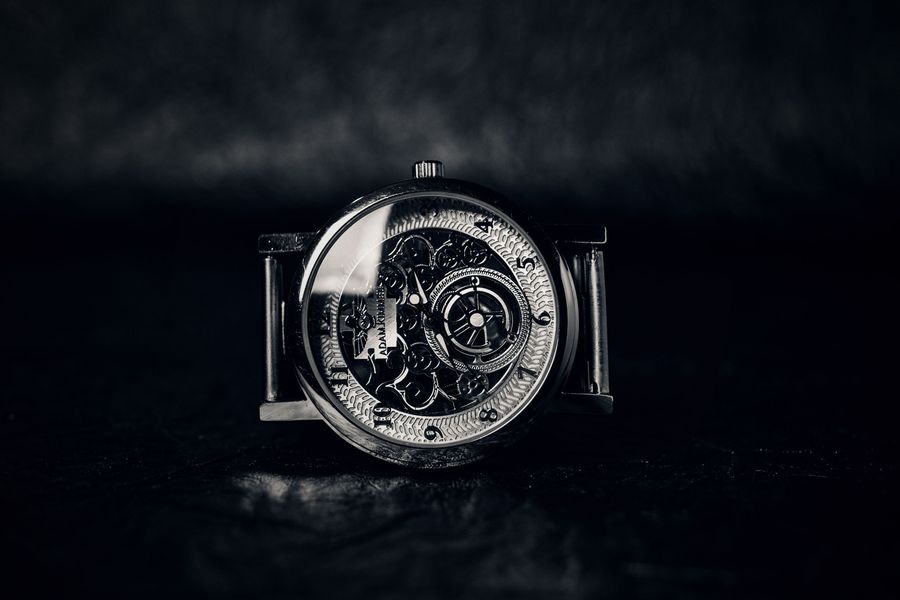
A mechanical watch is a different kind of time. Its seconds are not defined by atomic transitions but by the period of oscillation of a balance wheel — a wheel of brass or glucydur, attached to a hairspring of steel or silicon or a proprietary alloy, swinging back and forth at a frequency that depends on the spring's stiffness and the wheel's moment of inertia. These parameters are chosen by a watchmaker and are subject to variation: from temperature, from the orientation of the watch, from the state of lubrication in the movement, from the tension remaining in the mainspring.
The ticking of a mechanical watch is the sound of this process made audible. Each tick marks the passage of the escapement — the pallet fork catching and releasing the escape wheel, transferring a precise impulse to the balance wheel, allowing the gear train to advance by exactly one tooth. In a watch beating at 28,800 beats per hour — four beats per second — this process occurs 691,200 times in a day. It occurs while you sleep, while you eat, while you walk, whether you notice or not. It is, in the most literal sense, the watch keeping time for you: not reporting time from an external source but generating it, internally, from its own energy and geometry.
The Ethics of Imprecision
There is a school of thought, entirely defensible, that the slight inaccuracy of mechanical timekeeping is its primary virtue rather than its primary defect. The argument runs like this: time, as a human experience, is not precise. A happy afternoon passes in what feels like minutes; a difficult meeting extends subjectively for what feels like hours. The emotional weight of a minute varies enormously depending on context. Atomic time brackets and counts these minutes without regard to their quality. Mechanical time — slightly fast, slightly slow, requiring a weekly adjustment, never quite right — acknowledges, by its very imprecision, that absolute temporal accuracy is a technical achievement rather than a human necessity.
This is not nostalgia. It is a recognition that different tools are appropriate for different purposes. A stopwatch timing a sprint needs precision to the thousandth of a second. A watch telling you whether it is time for lunch does not. The gap between these requirements is large enough to contain the entire appeal of mechanical timekeeping — the space in which precision matters less than character, and where the particular qualities of a specific mechanism can be appreciated for their own sake.
The Tactile Argument
There is also a simpler argument, which does not depend on philosophy at all. A mechanical watch is a physical object of considerable complexity and, in the better examples, considerable beauty. It has weight. It has movement — actual movement, visible through the caseback or through an open dial. It generates a sound. When you wind it, you participate in its energy cycle; when you feel it running down, you are reminded that it is a finite system requiring maintenance, not an infinite service delivered from elsewhere.
These qualities matter to a species that evolved in a world of physical objects and that still, despite decades of digitisation, prefers to interact with things it can touch, weigh, and hear. The smartphone delivers time with perfect accuracy and zero sensory engagement. The mechanical watch delivers time with imperfect accuracy and rich sensory engagement. The choice between them is not a choice between better and worse timekeeping. It is a choice about what role the instrument of timekeeping plays in your daily experience.
For those who choose the mechanical watch, the imprecision is not a flaw to be tolerated. It is evidence of a mechanism that is alive in the way that precision instruments are not quite alive — responsive to its environment, subject to the same physical forces as its wearer, running on a spring that was wound by a human hand. In this sense, the mechanical watch is the more honest instrument: it does not pretend to exist outside of time but demonstrates, with every tick, that it is in time alongside you.